When does chauffeured transportation make sense for a business trip?
The short answer is: choose chauffeured transportation when the trip is complex enough that driving, parking, navigating, or coordinating several separate rides could distract from the workday. A single airport transfer may be straightforward. A day involving Toronto Pearson International Airport, a downtown meeting, a client visit in Mississauga, and an evening return is a different planning problem.
For business travellers, the value is usually coordination rather than luxury. A reserved vehicle can give the itinerary one transportation plan, one set of pickup instructions, and one provider to contact when the schedule changes. It may also be practical when the traveller is carrying presentation materials, samples, trade-show equipment, or multiple pieces of luggage.
- One airport-to-hotel transfer: compare convenience and cost against other direct options.
- Three or more planned stops: consider a coordinated or hourly booking structure.
- Client or executive hosting: prioritise clear instructions, professional presentation, and vehicle fit.
Start with the itinerary, not the vehicle
A common mistake is choosing a vehicle first and trying to fit the itinerary around it. Begin with the workday. List every location in order, the expected arrival window, the meeting length, and whether the traveller needs transportation between stops. Include hotels, offices, restaurants, conference venues, private terminals, and return airports where relevant.
For a Toronto or GTA itinerary, write the actual municipality and full address for every stop. “Downtown Toronto” is not enough for a precise quote or dispatch plan. A booking brief should distinguish a hotel entrance from a loading area, a corporate reception from a private residence, and a venue address from a nearby parking entrance.
How to plan airport pickups at Toronto Pearson
Airport travel needs more than an aircraft arrival time. A passenger may need time for disembarking, customs or immigration, baggage collection, and walking to the agreed pickup point. For a departure, the calculation runs in the opposite direction: meeting time, airport access, check-in, security, and any baggage or document requirements all affect the recommended pickup time.
Do not instruct an arriving executive simply to “meet outside.” Send the terminal, door, level, provider or company name, passenger contact number, and a backup communication method. Pearson states that pre-arranged services should be arranged directly with the chosen company and that arriving passengers should proceed to the designated area and notify the dispatcher. (torontopearson.com)
Vehicle selection: passenger comfort, luggage, and workday purpose
Vehicle selection should reflect the whole load, not only the number of people. Two executives with carry-on bags may have different needs from two executives with garment bags, product cases, or golf equipment. A group may fit by seat count but still feel cramped once luggage is loaded.
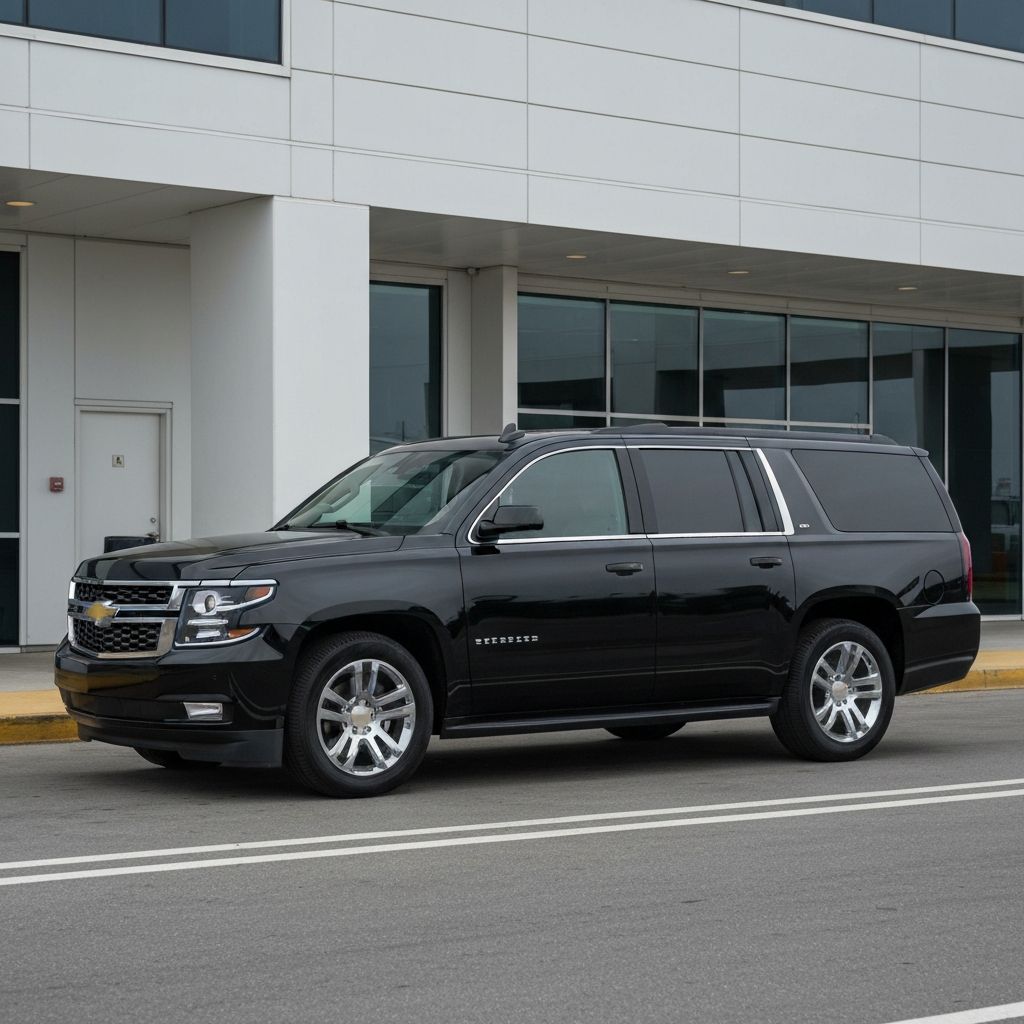
Our public fleet pages list Cadillac Escalade, Chevrolet Suburban, GMC Yukon XL, Mercedes Sprinter, stretch limousine, and party-bus options, subject to confirmation. For corporate travel, a luxury SUV may suit a small executive group with ordinary luggage, while a Sprinter may be more practical for a larger group or more equipment. A stretch limousine or party bus is generally a purpose-specific choice rather than the default for a meeting-heavy workday.
Point-to-point or hourly chauffeur service?
Point-to-point service is usually easier to understand when the trip has one pickup and one destination. It can also suit a return transfer when the passenger will arrange separate transportation during the day.
An hourly or vehicle-at-disposal structure may be worth comparing when the itinerary has uncertain meeting lengths, several stops, or a need to leave one location promptly. The tradeoff is that the booking structure may be less economical than separate transfers if the vehicle would sit unused for long periods. Ask the provider to quote the structure that matches the actual pattern rather than assuming one format is always best.
A procurement-ready booking brief
Office managers and executive assistants can save time by sending the same structured information to each provider. This makes comparisons fairer and reduces follow-up questions. It also creates a useful internal record of what was requested, what was confirmed, and who approved the booking.
Here is an original booking-brief template you can copy into an email or booking form:
Questions to ask before booking
A professional comparison is not just a price comparison. Ask questions that reveal whether the provider has understood the trip and whether the proposed service matches the traveller’s responsibilities.
We recommend requesting answers in writing, especially for executive travel, multi-stop schedules, and airport arrivals. Vehicle, route, timing, price, and availability must be confirmed for each booking.
Five-point executive travel score
Score complexity, schedule sensitivity, luggage or equipment, client hosting, and workday focus from 0 to 2. Use the total to decide whether to compare a direct transfer, coordinated option, or complete chauffeur plan.
Procurement-ready booking brief
Send the trip purpose, local date and time, passenger contact, complete stop sequence, airport details, luggage and equipment, requested booking structure, billing requirements, change authority, and confirmation questions to each provider.
Ready to discuss an executive itinerary? Review our corporate transportation information, contact Toronto A1 Limo with your trip details, or request a booking through our online form.