Build one transportation plan for every hotel, not separate bookings
For wedding guest transportation from Toronto hotels, we coordinate hotel pickups, venue arrivals, and return rides as one movement plan. Treating each hotel as an isolated booking can create gaps in guest counts, pickup instructions, vehicle timing, and day-of communication. A single itinerary gives your planner, hotel contacts, venue team, and our dispatch team one working version of the schedule.
Start with the time guests must be inside the venue, then list every hotel, the guests assigned there, luggage requirements, accessibility needs, pickup wave, return arrangement, and day-of contacts. This makes it easier to identify where shared transportation is practical, where a separate route is safer, and where a later departure wave is needed.
Toronto hotels are distributed across many distinct neighbourhoods and visitor areas. Destination Toronto identifies more than 140 neighbourhoods, so properties that appear close on a guest list may have different entrances, traffic conditions, and loading procedures. We plan around the precise hotel entrance and venue deadline rather than a broad district label.
- Create one master itinerary for every hotel and every travel wave.
- Name the exact passenger pickup point, not only the hotel address.
- Use one guest-facing instruction format across all properties.
- Assign one organizer and one backup contact for transportation decisions.
- Keep the hotel-by-hotel counts current until the rooming list is stable.
| Master-plan item | Why it matters |
|---|---|
| Required venue arrival time | It determines every pickup and route decision that follows. |
| Guest count by hotel | It supports realistic vehicle allocation and reduces empty or missing seats. |
| Hotel loading instruction | It helps guests and chauffeurs meet at the same confirmed location. |
| Return-wave assignment | It prevents uncertainty when guests are ready to leave the reception. |
Create a hotel-and-guest transportation worksheet
A wedding total is not enough for multi-hotel transportation planning. Record how many guests are leaving from each property, whether they travel in the same wave, and whether they will have overnight bags, garment bags, strollers, mobility aids, or other items that affect usable space and boarding time.
Use the hotel’s complete public-facing name and full street address. Large properties may have several entrances, and the main lobby doors may not be the appropriate loading point. Ask the hotel which entrance should be used, whether the driveway permits waiting, whether height restrictions apply, and who should be called if access is temporarily blocked.
Keep the worksheet live. When guests switch hotels, arrive late, or decide to drive themselves, revise the count for that individual hotel rather than changing only the overall total. That detail allows us to review the route and vehicle plan before an overlooked group becomes a day-of problem.
- Hotel name, full address, and designated pickup entrance.
- Guest count assigned to the hotel and planned pickup wave.
- Expected bags, formalwear, strollers, and mobility aids.
- Hotel loading instructions and a hotel day-of contact.
- Organizer contact, backup contact, and guest message channel.
- Return-wave assignment and latest boarding time.
| Worksheet field | Example planning note |
|---|---|
| Venue arrival deadline | Guests need to be inside the venue by 4:30 p.m., not arriving at the driveway at 4:30 p.m. |
| Hotel pickup window | Board from 3:20 to 3:30 p.m.; depart promptly at 3:35 p.m. |
| Passenger and luggage count | Ten guests with overnight bags may require a different arrangement than ten guests travelling light. |
| Meeting instruction | Meet at the confirmed side entrance, rather than the main lobby doors. |
Group hotels by movement pattern, not map distance
Hotels that look nearby do not automatically belong on the same route. We group properties by movement pattern: venue arrival deadline, expected loading time, passenger count, luggage, curb access, and whether a shared pickup would create an unnecessary detour. This is more dependable than using distance alone.
Airport-area hotels can be useful for guests arriving through Pearson, but combining an airport pickup with a downtown pickup may add complexity when both groups need to reach the venue at the same time. Downtown properties in areas such as the Financial District, South Core, Waterfront, Yorkville, and Old Town can also have different access conditions. Confirm each property’s actual loading instructions before combining it with another stop.
Separate departure waves can improve both timing and guest experience. An early wave may suit guests attending a welcome moment, helping with setup, or wanting extra time before the ceremony. A later wave may suit the main group. State clearly who belongs in each wave, and avoid making one vehicle wait indefinitely for guests assigned to another departure.
- Combine hotels only when route order and arrival targets support it.
- Treat airport-area and downtown transportation as separate movements unless the itinerary supports a shared route.
- Use early and later waves when guests have different arrival needs.
- Do not use “downtown hotel” as the final pickup instruction.
- Review actual entrances and loading conditions before assigning a route.
| Route question | Planning result |
|---|---|
| Can both groups board and arrive without a long detour? | A shared route may be practical. |
| Do the hotels have different access restrictions or departure needs? | Use separate vehicles or departure waves. |
| Are guests carrying luggage or mobility equipment? | Allow more space and longer loading time. |
| Does one group need to arrive earlier? | Assign that group to a dedicated first wave. |
Work backward from the time guests must be inside the venue
The critical time is when guests need to be inside and ready for the event, not when a vehicle reaches the venue driveway. Work backward through venue unloading, walking distance, guest-list or security procedures, route time, hotel loading, and a reasonable contingency buffer. Confirm the venue’s definition of arrival before publishing hotel departure times.
Hotel loading often takes longer than a headcount suggests. Guests may be using elevators, collecting coats, visiting the front desk, or returning to rooms for forgotten items. Venue arrivals can also take time when multiple vehicles reach the property near the same moment or must use a designated unloading point.
After calculating each departure, provide simple guest instructions: where to meet, when boarding begins, when the vehicle leaves, and whom to contact if they are delayed. Avoid vague language such as “around 3:30.” A stated boarding window and firm departure time make the plan easier to follow.
Confirm curbside conditions before final dispatch. The City of Toronto distinguishes among stopping, standing, parking, commercial loading, and passenger loading, and restrictions can apply on busy corridors. We do not assume a vehicle can wait wherever a map pin appears. Ask hotels and venues about the preferred entrance, security or valet procedures, height limits, waiting rules, and an alternate staging point.
- Calculate from the venue-ready deadline backward, not from an estimated driving time forward.
- Include hotel loading, venue unloading, entry time, and a contingency buffer.
- Confirm the venue entrance or unloading point for each arrival wave.
- Record an alternate entrance or staging plan before the wedding day.
- Avoid scheduling extended curbside waiting where restrictions may apply.
| Work-back step | What to confirm |
|---|---|
| Venue-ready deadline | The exact time guests must be inside the venue. |
| Venue arrival process | Unloading area, walking distance, and guest entry procedures. |
| Route time | A realistic route between the confirmed hotel entrance and venue access point. |
| Hotel loading time | Boarding window, bags, elevators, and pickup-point instructions. |
| Contingency buffer | Time reserved for normal operational variation or access changes. |
Choose vehicles by usable capacity, access, and timing
Passenger count is the starting point, not the complete vehicle decision. Guests travelling with overnight bags, formalwear, mobility aids, or children’s equipment need more practical space and often more boarding time than the same number of guests travelling light. We review counts hotel by hotel rather than assuming the wedding’s total attendance translates into one vehicle arrangement.
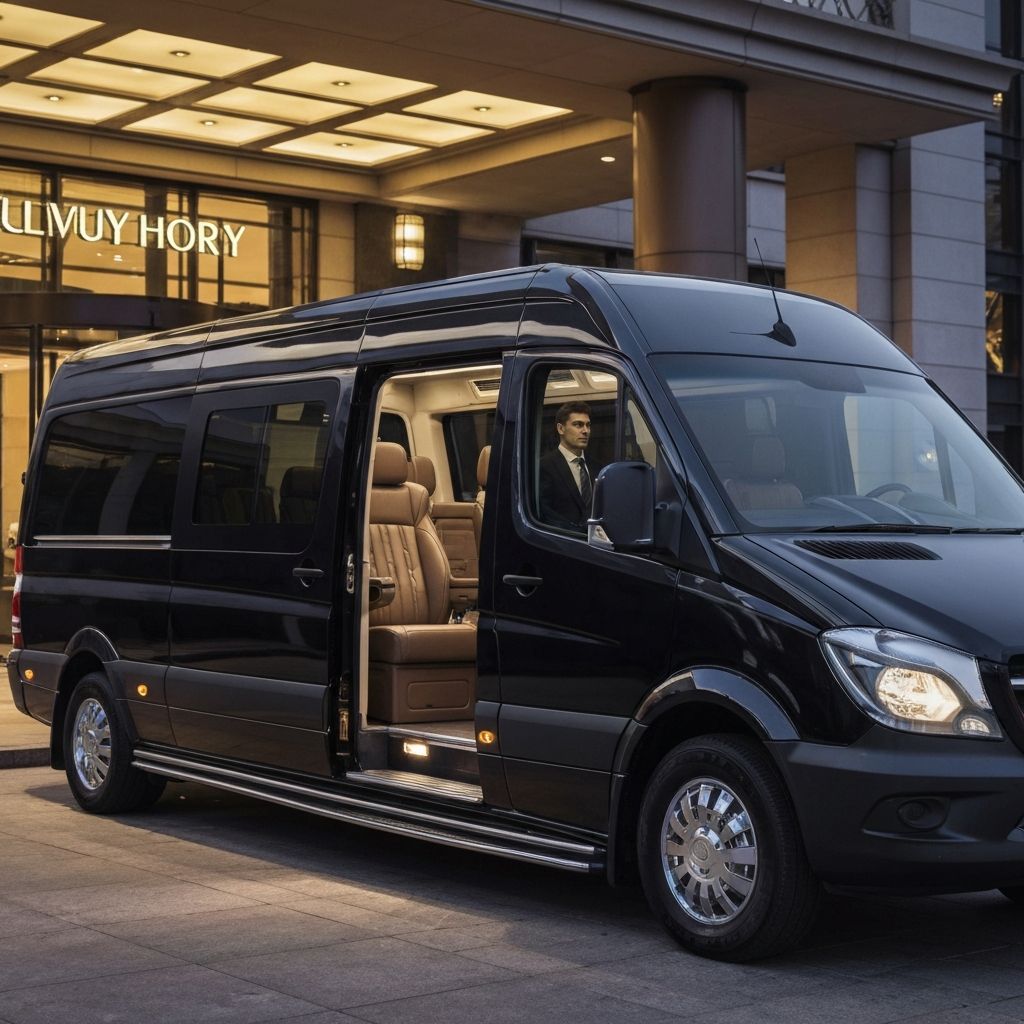
Our available categories include Cadillac Escalade, Chevrolet Suburban, GMC Yukon XL, Mercedes Sprinter, stretch limousine, and party-bus options, subject to availability and itinerary confirmation. SUVs can be useful for smaller groups, family members, or a separate VIP movement. Sprinter-style transportation can support coordinated hotel-to-venue transfers. Stretch limousines and party-bus options may suit celebration-focused transportation when the route, passenger count, access conditions, and return schedule fit the plan.
Two smaller vehicles on separate hotel routes may be more dependable than one larger vehicle expected to collect guests from several locations in a narrow window. Conversely, one coordinated group vehicle can simplify communication when a single hotel has sufficient passengers and suitable loading access. We review the schedule and pickup points before recommending a setup based on vehicle appearance alone.
- Use hotel-specific counts rather than the overall wedding guest count.
- Account for bags, formalwear, strollers, mobility aids, and boarding time.
- Match vehicle selection to driveway access and route sequence.
- Confirm final availability before issuing guest pickup instructions.
- Consider separate routes when a combined route creates a narrow or fragile schedule.
| Planning situation | Possible approach | Confirm before finalizing |
|---|---|---|
| Small group at one hotel | An SUV or similar smaller-group arrangement may fit. | Passenger count, luggage, and return needs. |
| Coordinated group at one hotel | A Sprinter-style group movement may simplify boarding. | Usable capacity, driveway access, and departure window. |
| Celebration-focused travel | A stretch limousine or party-bus option may fit the occasion. | Venue access, route, passenger count, and return timing. |
| Guests at several hotels | Separate routes or waves may reduce detours. | Each pickup point, route order, and venue deadline. |
Include accessibility, returns, and contingency communication in the main itinerary
Accessibility belongs in the first worksheet, not in a last-minute exception. Ask guests privately and early about transportation support. Record operational needs such as mobility aids, step-free access requirements, assistance with boarding, service-animal information, or travel with a support person. Share only the information needed to arrange transportation respectfully.
Ontario guidance on accessible transportation is useful planning context, including the importance of accessible information and appropriate arrangements. Specific vehicle and site features must still be verified for the actual trip. We do not promise a particular accessibility feature until it is confirmed for the selected vehicle, hotel pickup point, and venue access route.
Plan the return journey with the same care as the outbound transportation. Decide whether guests return in one stated window, in scheduled waves, or through a separate late-night arrangement. Repeat the return pickup location and departure times in the final event message, especially if the return location differs from the arrival entrance.
Establish one communication chain for the day. The organizer, venue contact, hotel contact, and our day-of contact should know who may approve a route change and who will send a delay update. Guests should receive one clear message channel instead of conflicting instructions from several people.
- Collect accessibility information privately and confirm arrangements in advance.
- Verify vehicle, hotel, and venue conditions for the actual itinerary.
- Choose stated return windows or waves before guests arrive at the venue.
- Explain the return pickup location plainly if it differs from the arrival entrance.
- Name one authorized decision-maker and one backup contact.
| Day-of scenario | Prepared response |
|---|---|
| Primary hotel entrance is unavailable | Use the confirmed alternate entrance and send one approved guest update. |
| A guest misses the departure window | Contact the named organizer to determine the approved next step. |
| Return guests leave at different times | Use the pre-announced return wave or late-night arrangement. |
| An accessibility need changes | Review the actual vehicle and access conditions before confirming a revised plan. |
Multi-hotel wedding transportation worksheet
For every hotel, record the exact address and pickup entrance; guest count; luggage and mobility-aid details; boarding window; firm departure time; required venue arrival time; hotel loading instruction; hotel contact; organizer and backup contact; return wave; and late-night communication contact.
Work-back departure calculation
Latest departure equals the required venue arrival time minus planned route time, hotel loading time, venue unloading and entry time, and a contingency buffer. Calculate this for each hotel pickup wave, then test whether the route order is realistic.
People, Place, Pace, Plan B
Test each arrangement with four questions: Who is travelling and what do they need? Where will they load and unload? When must they be inside the venue? What is the approved alternate route, entrance, or communication step if the original plan changes?
When your hotel list is ready, send us the addresses, guest counts, venue arrival deadline, and preferred return plan. We can help you coordinate a wedding transportation service plan, review hotel transportation planning details, compare fleet options, or confirm your request through our contact page or online booking.
Sources
- Plan Your Trip to Toronto
- Toronto Areas & Neighbourhoods
- Plan Your Visit to Toronto for the Game
- Toronto Municipal Code Chapter 950: Traffic and Parking
- Schedule VII: Passenger Loading Zones
- City of Toronto and Toronto Police Service No Stopping Enforcement Blitz
- Street Event Permit
- How to provide accessible transportation services