The short answer: confirm the vehicle before confirming the reservation
Accessible airport transportation is not determined by passenger count alone. The key question is whether a specific vehicle can safely accommodate the passenger, their boarding method, mobility aid, companions, and luggage for the exact trip. A standard luxury SUV may suit a traveller who can transfer into a seat and has a folding walker or wheelchair. It may not suit a traveller who needs to remain in a non-foldable mobility aid during the ride.
Toronto Pearson advises travellers using pre-arranged transportation to contact their provider and ask whether the vehicle can carry a non-foldable or non-collapsible mobility aid. That is an important starting point, but it does not replace confirmation of the complete arrangement. The dimensions and weight of the aid, transfer ability, bags, route, pickup conditions, and vehicle configuration can all affect suitability.
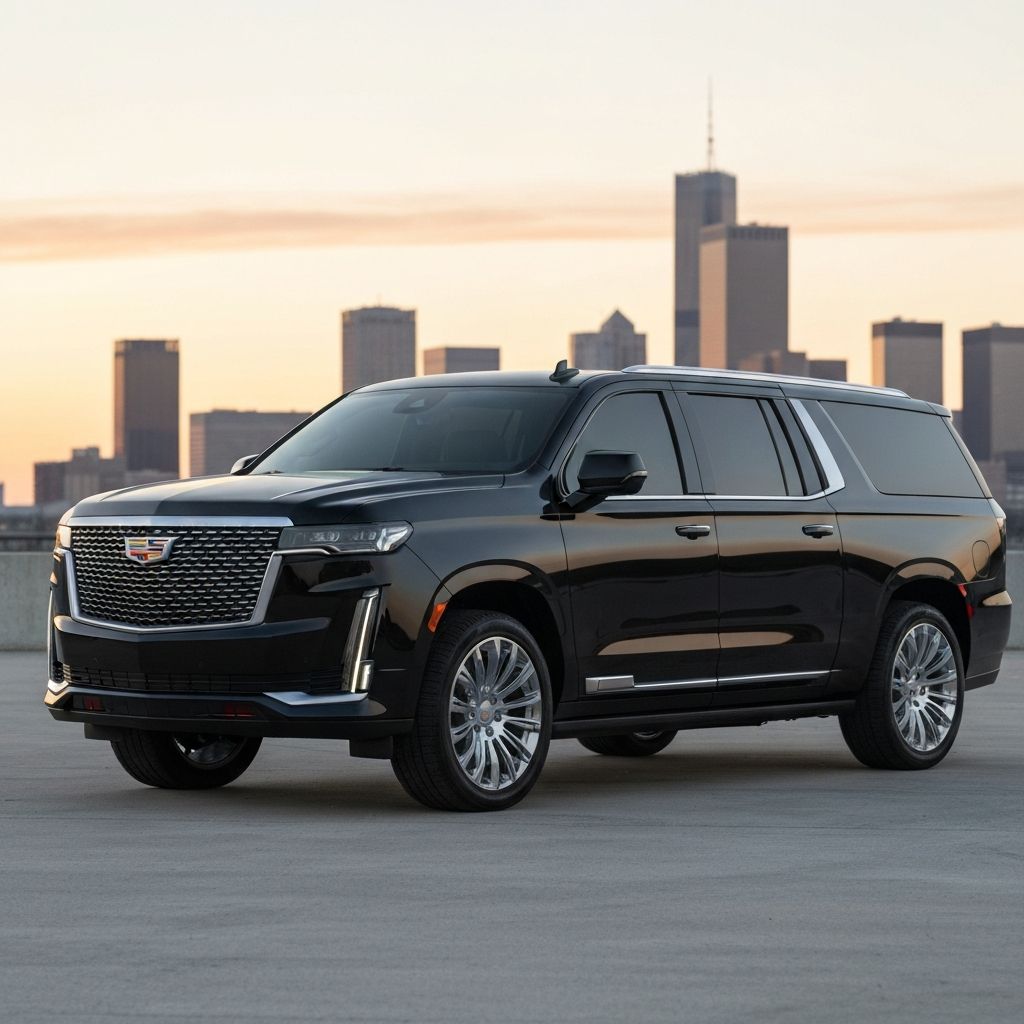
When you contact us, provide the relevant details before relying on a reservation. We can review the request and confirm whether the proposed vehicle, route, timing, and availability are suitable. Our public fleet information includes Cadillac Escalade, Chevrolet Suburban, GMC Yukon XL, Mercedes Sprinter, stretch limousine, and party-bus options, but not every vehicle is appropriate for every accessibility requirement or itinerary.
- Treat accessibility as a vehicle-fit and trip-planning question, not only a booking-note question.
- State whether the mobility aid will be folded and stored or whether the passenger needs to remain in it during travel.
- Ask for confirmation of the specific vehicle arrangement before making other travel plans around the ride.
| Question to resolve | Why it affects the transfer |
|---|---|
| Can the passenger transfer into a standard vehicle seat? | This affects boarding, seating, and whether a conventional passenger vehicle may be suitable. |
| Will the mobility aid fold or collapse? | A folded aid may require cargo space, while a non-foldable aid requires more specific confirmation. |
| How much luggage and how many companions are travelling? | Passenger seating and cargo capacity must work at the same time. |
Step 1: describe the passenger’s mobility needs clearly
The term accessible can describe many different needs. One passenger may need extra time at the curb and help placing a walker in the vehicle. Another may need a lower step, a steady boarding process, a companion seated nearby, or transportation that can accommodate an occupied mobility aid. A useful request describes the actual need instead of relying on a broad label.
Start with boarding. Explain whether the passenger can climb vehicle steps, whether they can transfer independently or with a companion’s help, and whether they can sit comfortably in a standard passenger seat for the expected journey. If the passenger cannot transfer from their chair or scooter, say so immediately. A spacious vehicle, a large door opening, or a luxury vehicle category does not automatically mean it can transport an occupied mobility device.
Identify the mobility aid precisely. Provide its type, whether it folds, its dimensions when open and folded, and relevant weight or battery information supplied by the manufacturer. Mention accessories that change the practical footprint, including elevating leg rests, headrests, oxygen equipment, cushions, cane holders, or a second aid. These details help prevent a last-minute mismatch between the vehicle and the equipment.
Ontario’s transportation accessibility guidance provides useful general context on provider responsibilities and mobility aids. This article is practical planning information, not legal advice. For a trip-specific answer, we still need to evaluate the particular request.
- Describe transfer ability, not only a diagnosis or condition.
- Measure the mobility aid at its widest, longest, and tallest point.
- Tell us whether the aid must stay upright and whether it can be folded or disassembled.
- Mention medical equipment and companion support needs that affect space or timing.
| Detail to provide | Why it matters |
|---|---|
| Transfer ability | It helps determine whether seating and boarding in the proposed vehicle may be appropriate. |
| Open and folded dimensions | It helps us assess storage space and handling requirements. |
| Equipment and accessories | Items such as oxygen equipment or leg rests can change the required passenger and cargo space. |
Step 2: choose the vehicle around people, equipment, and luggage
A reliable vehicle decision considers three separate requirements: passenger seating, mobility-aid handling, and luggage capacity. A vehicle may have enough nominal seats for a family but still be impractical once a wheelchair, walker, carry-on bags, winter outerwear, car seats, or medical supplies are included. Counting seats without counting equipment is a common planning error.
For a passenger who transfers into a seat, a luxury SUV may be worth discussing when the aid folds and the combined luggage load fits. We publicly list Cadillac Escalade, Chevrolet Suburban, and GMC Yukon XL options, subject to confirmation for the booking. For a larger travelling party or additional bags, a Mercedes Sprinter may be worth discussing. Its suitability still depends on the mobility aid, boarding needs, and interior arrangement.
Avoid selecting a vehicle solely from photographs or generic capacity descriptions. Ask how the passenger will enter, where the aid will be placed, whether all luggage can travel with the group, and whether the setup leaves a clear, safe path for boarding and exiting. If an answer is uncertain, pause and confirm rather than treating uncertainty as approval.
For broader trip planning, our airport limousine service page can help organize transfer details. If you are comparing vehicle types, use the same focus on actual passengers, equipment, luggage, and boarding requirements.
- Give the luggage count as checked bags, carry-ons, and oversized items.
- Include car seats, strollers, service-animal supplies, and medical bags in the space plan.
- Ask whether the passenger’s aid and luggage will remain with the travellers throughout the transfer.
- Do not assure another traveller that a vehicle will fit until the arrangement is confirmed.
| Planning factor | Question to ask |
|---|---|
| Passenger space | Can the passenger board, sit, and exit safely with the proposed seating arrangement? |
| Mobility-aid handling | Where will the aid be stored, and can it be handled as required? |
| Luggage capacity | Will all bags and essential equipment fit without compromising seating or boarding space? |
Step 3: plan Pearson pickup and drop-off logistics
Airport accessibility planning includes the curb and terminal route, not just the vehicle. Toronto Pearson identifies designated pre-arranged limousine pickup areas at Terminal 1 Door A and Terminal 3 Door A. The airport advises passengers using a pre-arranged limousine to go to the designated area and notify the dispatcher that they are waiting. Confirm the terminal in advance, because a correct vehicle at the wrong terminal or meeting point can create an unnecessary wait.
For an arriving traveller, agree on what happens after landing. International arrivals can be delayed by deplaning, border formalities, baggage collection, mobility assistance, and the time needed to reach the public pickup area. Scheduled landing time is not the same as curb-ready time. Share the flight number, confirm how updates will be exchanged, and make sure the traveller or companion knows the designated meeting procedure.
For a departure, Toronto Pearson lists accessible drop-off locations on the Departures Level of each terminal to assist people travelling with wheelchairs and mobility aids. Confirm the airline and terminal before travel, then share the drop-off plan with every companion. A companion who knows the door, luggage plan, and assistance needs can reduce pressure at a busy curb.
Use our airport information page when organizing terminal details, but check Pearson’s current instructions before travel because airport procedures and curb conditions can change.
- Confirm Terminal 1 or Terminal 3 before the day of travel.
- For arrivals, plan from curb-ready time rather than scheduled landing time.
- For departures, identify who will manage bags, mobility aids, and communication at the curb.
- Keep a phone charged and ensure the traveller has our contact details.
| Trip direction | Key planning point |
|---|---|
| Pearson arrival | Confirm the terminal, designated limousine pickup area, flight number, and travel-day communication plan. |
| Pearson departure | Confirm the terminal, accessible drop-off plan, airline timing guidance, and luggage responsibilities. |
Step 4: build enough time into the airport plan
Drive time is only one part of an accessible transfer. Boarding can take longer when a traveller needs a stable pace, when a mobility aid must be folded or stored, or when several bags need careful handling. At Pearson, the distance from the curb to check-in, security, or the pickup area can also add time. Build the schedule around the traveller’s pace rather than trying to compress the process into a standard curbside stop.
For a departure, use this planning equation: planned pickup time equals the airport arrival target minus the unloading and boarding buffer, minus the road-trip estimate, minus a traffic and weather buffer. For example, if the target is to arrive at Pearson at 6:00 a.m., unloading and entering the terminal may take 20 minutes, the drive may take 45 minutes, and the selected traffic and weather buffer is 30 minutes. The planned pickup time is 4:25 a.m.
This calculation is a planning tool, not an airline check-in rule. The final airport-arrival target should reflect airline guidance, the destination, baggage requirements, and the traveller’s personal needs. In winter or during major events, consider whether a larger road buffer is appropriate. For arrivals, apply the same principle in reverse by allowing flexibility for delayed flights, baggage collection, and a longer route from the terminal to the pickup point.
- Add a boarding and unloading buffer that reflects the traveller’s actual pace.
- Separate the airport-arrival target from driving time.
- Use flight tracking and direct communication for arrivals.
- Review the timing plan if the flight, terminal, passenger count, or luggage count changes.
| Time element | Example allowance |
|---|---|
| Airport arrival target | 6:00 a.m. |
| Unloading and terminal-entry buffer | 20 minutes |
| Road-trip estimate | 45 minutes |
| Traffic and weather buffer | 30 minutes |
| Planned pickup time | 4:25 a.m. |
Step 5: send a complete request before booking
A complete request gives us the information needed to review fit before the travel day. Include the pickup address, destination, date, preferred pickup time, flight number where applicable, airline, terminal, passenger count, luggage count, and mobility-aid details. Tell us who will communicate with the chauffeur or dispatcher if the passenger cannot manage calls or messages directly.
Be specific about assistance expectations. State whether a companion will fold and handle a walker, whether extra curbside time is needed, or whether the passenger needs a calm, unhurried boarding sequence. We can discuss the request, but travellers should not assume an unconfirmed vehicle arrangement will meet a need that was not disclosed.
We offer online booking and 24/7 service availability, but vehicle type, route, timing, price, and availability must be confirmed for each booking. Use contact us for a detailed discussion of mobility-aid and vehicle requirements, or submit the same complete information through online booking so we can review the reservation request.
Avoid generic descriptions such as “wheelchair passenger” without supporting details. Early disclosure allows us to review the request before travel day and helps reduce the chance that changed bags, a different terminal, or a larger mobility aid creates a mismatch at pickup.
- Provide the flight number, terminal, and arrival or departure direction.
- Include the pickup address and final destination.
- List passengers, checked bags, carry-ons, and oversized items.
- Provide mobility-aid type, open and folded dimensions, and transfer ability.
- Name a contact person and preferred method for travel-day updates.
| Before you submit | Information to include |
|---|---|
| Trip details | Date, time, addresses, airline, flight number, and terminal. |
| Space requirements | Passenger count, bags, oversized items, and equipment. |
| Accessibility details | Transfer ability, mobility-aid dimensions, folding status, and support needs. |
| Communication plan | The best contact person and method for travel-day updates. |
The Fit, Function, Flow, and Flexibility test
Use Fit for passenger, mobility-aid, and luggage space. Use Function for transfer ability, boarding, storage, and whether the aid remains occupied. Use Flow for the Pearson terminal, designated pickup or accessible drop-off point, and communication plan. Use Flexibility for delayed flights, changed bags, or changed mobility requirements. An unknown answer is a reason to confirm details before booking.
Departure pickup-time calculation
Planned pickup time equals airport arrival target minus unloading and boarding buffer, minus road-trip estimate, minus traffic and weather buffer. Example: 6:00 a.m. minus 20 minutes minus 45 minutes minus 30 minutes equals 4:25 a.m. Adjust the airport arrival target for airline guidance and the traveller’s needs.
Ready to discuss your Pearson transfer? Prepare the mobility-aid dimensions, passenger and luggage details, terminal, and flight information, then contact Toronto A1 Limo at 647-386-3868 or submit a reservation request through our online booking page.