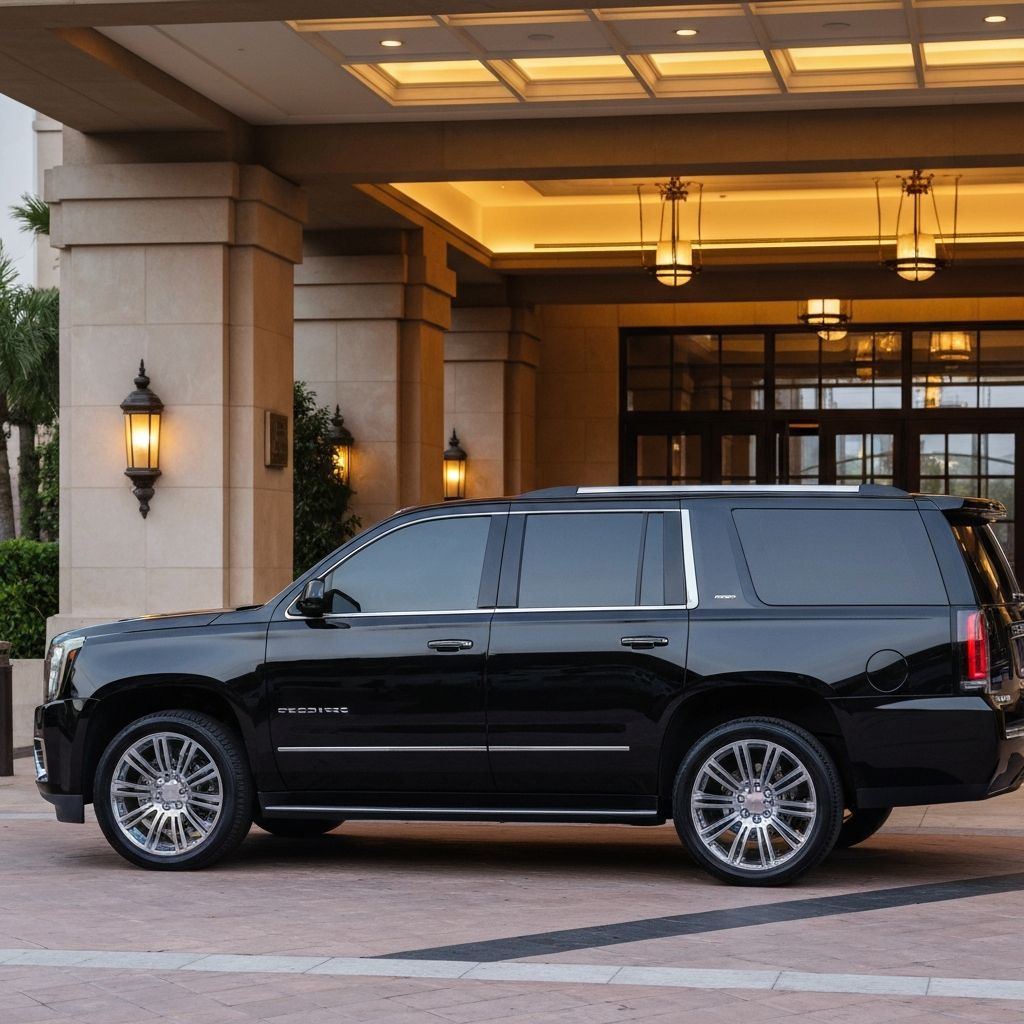
The short answer: choose around the trip, not the vehicle name
A luxury SUV is usually the practical starting point for a small party, moderate luggage, airport transfers, executive travel, hotel transportation, and flexible point-to-point trips. A Mercedes Sprinter is generally worth considering when more people, more bags, multiple stops, or a shared itinerary make a single SUV too restrictive. A stretch limousine is often the better fit when the occasion is formal or celebratory and the vehicle experience matters as much as the route.
These are planning categories, not promises about a specific assigned vehicle. Toronto A1 Limo publicly lists Cadillac Escalade, Chevrolet Suburban, GMC Yukon XL, Mercedes Sprinter, stretch limousine, and party-bus options. The appropriate vehicle, route, timing, price, and availability must be confirmed for each booking. Our fleet overview can help you begin the comparison, while a booking request lets us review the full itinerary.
- Choose a luxury SUV for simplicity, comfort, and everyday flexibility.
- Consider a Mercedes Sprinter for group coordination, luggage, and multi-stop travel.
- Consider a stretch limousine when formality and occasion atmosphere are central.
1. Start with a passenger-and-luggage count
The first useful number is not simply “how many people?” Write down the adults, children, mobility devices, child seats, garment bags, golf equipment, instrument cases, and checked or carry-on luggage. Two groups of four can need very different vehicles if one group has soft overnight bags and the other has large suitcases for an airport transfer.
Avoid treating a vehicle’s advertised seating category as a luggage guarantee. Passenger comfort depends on how much personal space people need and whether bags occupy the same rear area used for cargo. A practical request should state both the number of travellers and the luggage inventory. For example: “Four adults, four checked cases, four carry-ons, and one folding stroller” is more useful than “four passengers with luggage.”
2. Compare comfort as space, access, and trip rhythm
Passenger comfort is not just legroom. It also includes how easily people enter and exit, whether everyone can keep personal items close, how often the group must load and unload, and whether the itinerary allows the vehicle to remain with the party between stops.
A luxury SUV often suits travellers who want a simpler transfer with a smaller group. It can be a sensible choice for a corporate guest moving between an airport, hotel, and meeting, or for a family travelling with a manageable amount of luggage. If the group expects frequent stops, confirm whether the planned arrangement supports easy entry and exit without making the day feel cumbersome.
3. Match the vehicle to the itinerary
A point-to-point ride is easier to plan than a day involving several addresses. Before requesting a quote, list every stop in order, the desired arrival windows, how long the group may wait at each location, and whether the same vehicle should remain available throughout the outing.
For Toronto and regional Ontario travel, route conditions can change the practical shape of a day. Ontario’s Ministry of Transportation provides 511 Traveller Information Services for road closures, collisions, traffic, and construction, and its official road-map resources cover highways and regional routes. That does not create a guaranteed travel time, but it is a useful reminder to discuss the route rather than relying on a simple distance estimate. (ontario.ca)
4. Airport and accessibility details deserve early confirmation
Toronto Pearson has separate practical arrangements for taxis and limousines at Terminals 1 and 3. Pearson’s official accessibility guidance lists limousine pickup areas at Terminal 1 Arrivals, Door C, and Terminal 3 Arrivals, Door F. It also explains that passengers needing an accessible taxi or limousine for a non-folding mobility aid should use the pre-arranged desk inside the terminals by Door A. (torontopearson.com)
Pearson also advises passengers requiring mobility assistance to contact their airline in advance; the airport states that airlines are responsible for assistance from the curb to the aircraft and for handling mobility aids. A private transportation booking does not replace that airline-arranged support. (torontopearson.com)
5. Safety and restraint planning are part of vehicle selection
Transport Canada states that vehicles made for sale in Canada and imported into Canada must meet Canadian Motor Vehicle Safety Standards. Its safety-standards guidance also notes that regulations apply to specialty vehicles, including limousines. These are baseline vehicle standards; they do not answer whether a particular vehicle arrangement fits your party’s luggage, child restraints, or mobility equipment. (tc.canada.ca)
For children, Transport Canada advises that a seat belt should fit snugly across the hips and lie across the shoulder, and that a booster should continue to be used when the belt does not fit properly. Parents should provide the child’s age, size, and restraint needs when asking about a booking. (tc.canada.ca)
6. A practical decision framework for Toronto trips
Use the following five-part scorecard before contacting Toronto A1 Limo. Give each factor a score from 0 to 2: 0 means low importance, 1 means moderate importance, and 2 means high importance.
1. Passenger load: How important is keeping the full group together? 2. Luggage load: How much space do bags or equipment require? 3. Stop count: How many times will people load and unload? 4. Occasion formality: How important is a ceremonial or event-specific presentation? 5. Access complexity: How difficult are the pickup points, garages, terminals, or venues?
The five-part vehicle scorecard
Score passenger load, luggage load, stop count, occasion formality, and access complexity from 0 to 2. Use the pattern to decide which vehicle category to discuss first, then request confirmation.
Movement-load check
Multiply the number of passengers by the number of planned loading events. Six passengers and three loading events create 18 passenger-movements before luggage and equipment are counted. The result is a planning signal, not a vehicle-capacity rule.
Ready to compare your options? Review the Toronto A1 Limo fleet, then book your trip with the passenger, luggage, stop, and access details needed for a proper vehicle recommendation.