The short answer: confirm the whole travel plan, not just the vehicle name
Before booking a luxury SUV service in Toronto or a Mercedes Sprinter, give the provider five details: the number of passengers, the number and type of bags, child-seat requirements, mobility or boarding needs, and the complete pickup and drop-off plan. The right vehicle depends on how these details work together.
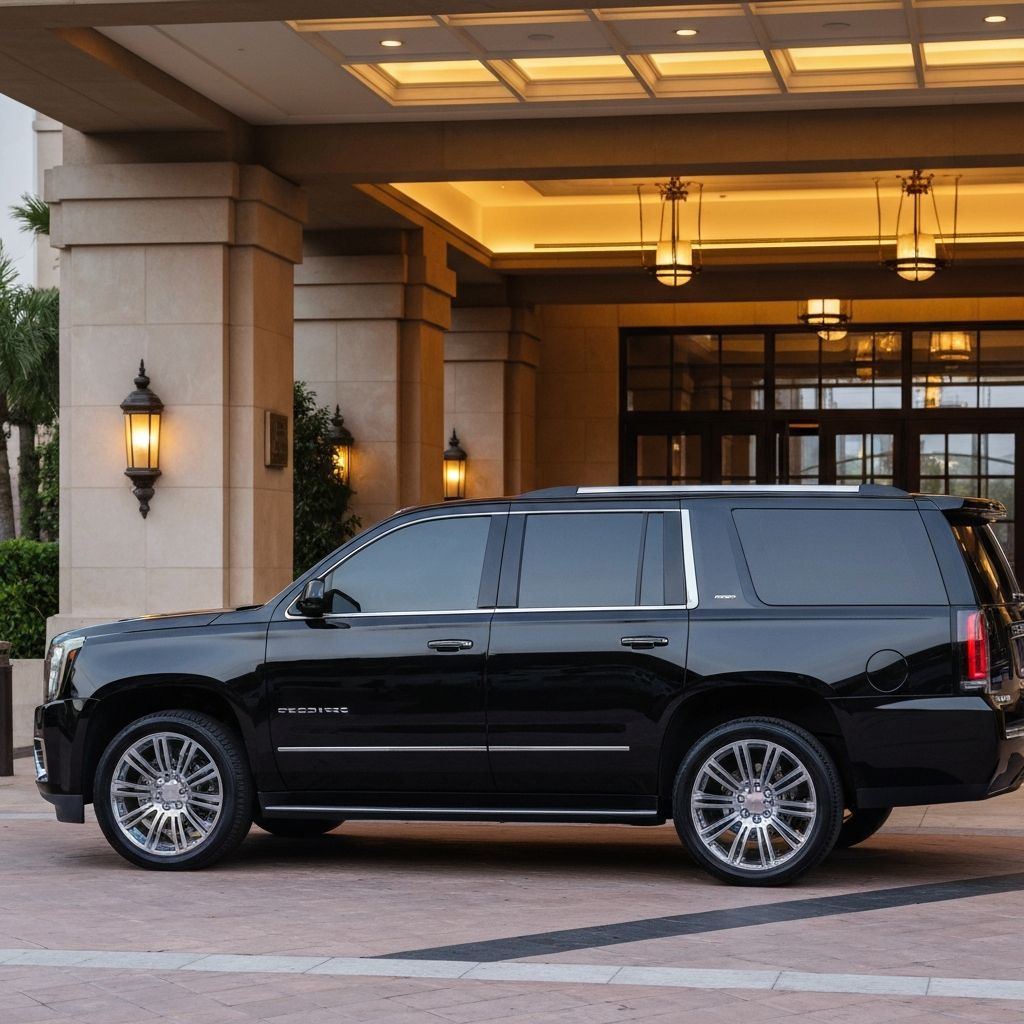
A luxury SUV may suit a family or small group travelling with a moderate amount of luggage and a straightforward route. A Sprinter may be more appropriate when the group needs more shared cabin space, easier movement between stops, or room for additional equipment. Neither conclusion should be based on a vehicle label alone. Exact vehicle assignment, dimensions, availability, and luggage fit must be confirmed for your date and itinerary.
At Toronto A1 Limo, we list Cadillac Escalade, Chevrolet Suburban, GMC Yukon XL, Mercedes Sprinter, stretch limousine, and party-bus options. We confirm the practical fit for each reservation rather than treating a model name as a guarantee. You can review vehicle categories on our fleet page before contacting us.
1. How many people are travelling, and how much personal space do they need?
Start with the real passenger count, including children. Then consider whether everyone will be seated for a short transfer, a longer airport journey, or a multi-stop day. A group that technically fits in a vehicle may still find the trip uncomfortable if passengers are carrying coats, backpacks, camera equipment, sports bags, or shopping.
Tell the provider whether anyone needs extra legroom, a particular seating position, assistance boarding, or time to enter and exit. If the trip involves older relatives, young children, or several stops, comfort and boarding time may matter as much as the number of seats.
A useful planning calculation is: practical space needed = passengers + child seats or mobility aids + luggage volume + movement space. This is not a manufacturer capacity formula; it is a conversation tool. If any category is uncertain, describe it rather than estimating optimistically.
- Count infants and children separately.
- Mention tall passengers or anyone requiring easier access.
- Explain whether the group will remain together for the full itinerary.
- Ask whether the confirmed vehicle can accommodate the stated passenger count without relying on unverified assumptions.
2. What luggage will travel with you?
Luggage is one of the most common reasons a vehicle that seems suitable becomes impractical. Give a count by type: checked suitcases, carry-on bags, soft duffels, golf bags, strollers, musical instruments, ski equipment, medical equipment, or other bulky items. If possible, provide approximate dimensions for unusual pieces.
For airport transportation, distinguish between bags travelling in the cabin and bags going into the luggage area. A family with four people and four standard suitcases presents a different requirement from four people with multiple hard cases, a stroller, and winter clothing.
For group travel, ask three direct questions: where will the luggage be placed, will all bags travel in the same vehicle, and is the proposed arrangement subject to a final visual or operational confirmation? We recommend sending photos or measurements for unusually large items. This gives the booking team better information than simply saying "we have a few bags."
- Number of large suitcases.
- Number of carry-on bags or backpacks.
- Strollers, wheelchairs, walkers, sports gear, or equipment.
- Whether bags must remain with passengers during multiple stops.
- Whether the group is travelling during a season when bulky coats or equipment are likely.
3. Are child seats or booster seats required?
Tell the provider the age, height, weight, and restraint stage of each child, and state whether you will bring the seat yourself. Ontario says children under 16 must wear a seatbelt, while children under eight must be properly secured in the appropriate child car seat or booster seat. The province also identifies height and weight milestones that affect when a child may use a seatbelt alone. (ontario.ca)
Transport Canada advises families to follow the child-seat manufacturer's instructions, check for a Canadian National Safety Mark, and stay informed about recalls and safety notices. (tc.canada.ca)
Do not assume that a provider supplies, installs, or accepts every type of child restraint. Ask what you are expected to bring, whether the confirmed vehicle has suitable seating positions, and who is responsible for installation. Parents and caregivers should follow the seat manufacturer's instructions; transportation booking staff can confirm vehicle details, but should not replace the manufacturer's safety guidance.
- Child's age, height, and weight.
- Rear-facing seat, forward-facing seat, booster, or seatbelt stage.
- Whether the family is bringing the restraint.
- Time needed to install and check each restraint before departure.
- Whether luggage placement could interfere with safe seating.
4. Does anyone use a mobility aid or need boarding assistance?
Describe mobility needs early and in practical terms. Say whether the aid is a folding walker, manual wheelchair, power wheelchair, scooter, or another device. Include approximate folded or overall dimensions, weight if relevant, and whether the passenger can transfer into a vehicle seat.
A standard luxury SUV or passenger Sprinter should not automatically be treated as an accessible vehicle. Ask what boarding arrangement is possible, whether the mobility aid can be safely transported, and whether an alternative vehicle or service is required. Ontario's accessibility guidance distinguishes between different transportation services and emphasises reducing barriers and planning for the individual's needs. (ontario.ca)
Our recommendation is to describe the need without relying on labels such as "accessible" or "easy access." Those terms can mean different things. A clear description of the passenger's movement and the aid's dimensions lets us determine what must be confirmed.
- Can the passenger climb vehicle steps?
- Can the passenger transfer from a wheelchair or scooter?
- Does the aid fold, and what are its dimensions when folded?
- Is a ramp, lift, securement system, or specialised accessible vehicle required?
- How much extra boarding time should be allowed?
5. What pickup details could affect the vehicle choice?
Give the full pickup address, not only the neighbourhood or hotel name. Include the entrance, terminal, curb, loading zone, condo instructions, venue access restrictions, and a contact person's mobile number where appropriate. For airports, state the terminal and whether the service is for an arrival or departure.
For hotels, ask where the vehicle can legally or practically wait and whether the driver needs to meet the passenger in a lobby or at a designated curb. For events, provide the venue, event start time, guest release time, and any planned staging location. For private homes, mention narrow drives, gates, steep grades, construction, or limited turning space.
A Sprinter or larger vehicle may require different stopping space from an SUV. This is why the physical pickup environment belongs in the booking conversation, especially for downtown Toronto buildings, busy venues, airports, and multi-stop itineraries. Our services overview can help you identify the appropriate booking category.
SUV or Sprinter: a practical comparison
The table below is a planning framework, not a promise of capacity or a substitute for confirmation. Vehicle fit depends on the specific vehicle assigned, passenger needs, luggage, and route. In every case, ask us to confirm the arrangement for your date.
| Planning question | Luxury SUV | Mercedes Sprinter |
|---|---|---|
| Small family or compact group | Often a natural starting point when passenger and luggage needs are moderate. | May be more vehicle than necessary for a compact party. |
| Several passengers travelling together | Can work when the group and bags fit the confirmed vehicle. | Often worth asking about when the group wants shared travel and more cabin room. |
| Large or unusual luggage | Confirm each item individually; cargo space can be the limiting factor. | Still requires confirmation because luggage type and seating layout affect usable space. |
| Multiple stops | Useful for a smaller itinerary if everyone can board efficiently. | May suit groups that want to stay together across a more involved itinerary. |
| Child seats or mobility needs | Ask about seating positions, access, and storage before choosing. | Ask about boarding, restraint placement, and whether the particular vehicle supports the need. |
| Pickup at a tight curb or residence | Confirm clearance, stopping space, and turning conditions. | Confirm access carefully because vehicle dimensions may affect the pickup plan. |
A five-minute booking checklist
Before requesting a quote or reservation, prepare this information:
- Date, requested pickup time, and expected end time.
- Passenger count, including children and infants.
- Luggage count, dimensions, and unusual equipment.
- Child-seat type and whether the family supplies it.
- Mobility aids, transfer needs, or boarding assistance.
- Exact pickup and drop-off addresses, terminals, entrances, and stops.
- Desired comfort level: direct transfer, shared family travel, or a more spacious group arrangement.
- Whether the trip is one-way, round-trip, hourly, or multi-stop.
- A mobile contact for the day of service.
- A request for the confirmed vehicle category and any remaining fit questions in writing.
Common mistakes to avoid
The first mistake is booking by passenger count alone. Six people with soft bags may present a different challenge from six people with hard cases and a stroller. The second is assuming a larger vehicle automatically solves every problem; seating layout, luggage placement, boarding access, and pickup space still matter.
Another mistake is leaving child restraints or mobility aids until the day of travel. Provide those details when requesting the reservation. Finally, do not treat an online vehicle photograph as confirmation of the exact vehicle for your date. Ask what is being confirmed and what remains subject to operational availability.
For airport planning, our airport limousine service page and related airport guidance can help you organise the transfer details. For a general vehicle-fit question, you can contact us before submitting the reservation request.
Our decision framework: choose the vehicle after answering four questions
Use this simple sequence:
1. **People:** How many passengers are travelling, and who needs extra space or boarding time? 2. **Payload:** What bags, child restraints, mobility aids, or equipment must travel? 3. **Place:** Can the pickup locations accommodate the vehicle and the planned loading process? 4. **Pattern:** Is this a direct transfer, an airport journey, or a multi-stop itinerary?
If the answers are straightforward and the group is modest, ask whether a luxury SUV is the practical fit. If the group wants to remain together with more shared space, or the itinerary involves several passengers and equipment, ask whether a Sprinter is more suitable. The final decision should come from confirmed details, not assumptions.
We provide reservation-based transportation across Toronto, the GTA, and Ontario, including airport, family, corporate, hotel, event, and private-jet transportation. Vehicle, route, timing, price, and availability are confirmed for each booking. When you are ready, request a reservation with the details above, or call 647-386-3868.
Practical space needed
Passengers + child seats or mobility aids + luggage volume + movement space. Use this as a conversation tool, not as a vehicle capacity specification.
People, Payload, Place, Pattern
Evaluate who is travelling, what must travel, where the vehicle must stop, and whether the itinerary is direct or multi-stop before choosing between a luxury SUV and Sprinter.
Ready to compare the options for your trip? Review our fleet, send the passenger and luggage details, and request confirmation through our booking page at /book. You can also call Toronto A1 Limo at 647-386-3868.