The short answer: provide the complete itinerary, not just a vehicle name
Before booking a Toronto limo service, share the full movement plan: travel date, pickup time or window, exact addresses, passenger count, luggage and equipment, flight or event information, stops, waiting needs, accessibility requirements, preferred vehicle, billing contact, return plan, and any timing risks. We can use those details to assess the route and discuss a vehicle and service arrangement that fit the trip rather than treating the request as a generic one-way ride.
A request such as “an SUV from Toronto to Pearson for four people” is a useful starting point, but it does not tell the whole story. Four travellers with four carry-ons create a different loading plan from four travellers with six large checked bags, a stroller, and a golf bag. Likewise, a pickup at a detached home is different from a pickup at a downtown condominium with a busy loading circle, concierge rules, or a particular tower entrance. Good information early in the process reduces assumptions on both sides.
- Start with the complete itinerary, including the return if one is expected.
- Use exact addresses, entrances, and contact details instead of broad location descriptions.
- Describe passengers, luggage, equipment, and support needs accurately before a vehicle is assigned.
| Booking detail | Why it matters | |
|---|---|---|
| Date, pickup time, and deadline | Helps assess scheduling, route timing, and whether the pickup is deadline-sensitive. | firm appointment or a flexible window. |
| Passenger and luggage count | Supports a realistic discussion about seating, storage, entry, and accessibility. | comfort. |
| Addresses, stops, and return plan | Clarifies route complexity, pickup logistics, waiting, and the service scope. | of the requested service. |
1. Date, pickup window, and the kind of timing you need
Give the calendar date and a practical pickup window, not only the time you hope to arrive. For example, “Pickup between 6:30 and 6:45 a.m. for an 8:30 a.m. international departure” gives much more planning context than “airport transfer in the morning.” Identify the hard deadline behind the ride: flight departure, meeting start, venue access time, ceremony, dinner reservation, ticketed entry, boarding time, or golf tee time.
It is also important to separate a precise appointment from a flexible availability period. A business traveller may need a vehicle ready at exactly 7:10 a.m. A wedding party may need transportation available across several movements between a hotel, photo location, ceremony, and reception. A concert or sports group may need a departure range that accounts for gathering the full group after an event. Tell the provider which time cannot move and which elements can change if traffic, event operations, or the group’s readiness require an adjustment.
- State the date, day of week, and local pickup time.
- Identify the non-negotiable deadline and the reason for it.
- Say whether the requested pickup is exact, approximate, or within a stated window.
| Situation | Useful wording | |
|---|---|---|
| Airport departure | Pickup at 6:35 a.m. from our home for a 9:15 a.m. international flight. | departure from Pearson.” |
| Corporate meeting | Vehicle required at 8:00 a.m.; the client presentation begins at 9:00 a.m. | 9:00 a.m. and arrival before 8:40 a.m. is preferred.” |
| Event return | The concert ends around 11:00 p.m.; please confirm the return pickup process. | post-event pickup point and timing will be handled.” |
2. Exact addresses, entrances, and pickup instructions
A street address is only the first part of a useful pickup instruction. Larger properties may have several towers, hotel driveways, office lobbies, loading zones, side streets, security desks, or entrances with different names. Provide the building name, unit or tower when relevant, preferred entrance, and the person who can help locate the group if the passengers are not immediately visible. For a residence, mention a gate, rural driveway, apartment buzzer, or other detail that could affect arrival and loading.
List every stop in the order it will occur, including short stops to collect a colleague, drop luggage, pick up a family member, or take photographs. A brief stop can still affect the route, timing, and quote. If curb access, construction, private security, venue rules, or loading restrictions may apply, raise that point before the booking is finalized. It is better to create a practical meeting plan in advance than to rely on last-minute instructions on a busy street.
- Include street number, street name, city, postal code, building name, and entrance.
- Provide all stops in order, with an estimated duration for each stop.
- Name one day-of-travel contact and provide a mobile number that will be monitored.
| Less useful | More useful | |
|---|---|---|
| “Pick us up at the hotel.” | Fairmont Royal York, main lobby driveway, 100 Front Street West. | Toronto.” |
| “The office downtown.” | Reception entrance at 250 Yonge Street; passengers will be ready at 6:30 p.m. | the Yonge Street doors.” |
| “Meet us at the venue.” | Scotiabank Arena, designated group meeting point confirmed by phone. | after the event.” |
3. Airport bookings: give flight, terminal, and meeting information
For an airport booking, provide the airline, flight number, terminal, origin or destination, scheduled time, passenger contact, and luggage details. Departures should be planned backward from the airline’s recommended airport-arrival time, with allowances for loading, road conditions, and terminal access. Arrivals require time after landing for deplaning, border procedures when applicable, baggage claim, and movement to the confirmed meeting area. Scheduled landing is not the same as pickup readiness. Confirm the terminal, designated meeting method, and contact procedure before travel day. If the airline changes the flight number, terminal, or time, send the update to the transportation provider promptly.
- Provide airline, flight number, travel date, and arrival or departure direction.
- State the terminal when known, but ask us to confirm the practical meeting plan.
- Mention checked bags, oversized items, delayed baggage, and any traveller who may need additional time.
| Airport detail | Why to include it | |
|---|---|---|
| Arrival flight number | Connects the request to the incoming flight and supports status checking. | the arrival context. |
| Terminal and meeting method | Supports a clear plan for the designated pickup location and passenger contact. | communications. |
| Departure deadline | Lets the itinerary be planned backward from the required airport-arrival time. | rather than guessed from a general morning pickup. |
4. Passenger count is only half of the capacity question
Tell the provider how many adults, children, and teenagers are travelling, as well as any passenger who needs extra room, a lower step-in height, more time to board, or help handling belongings. Seat count is not the same as a comfortable or workable travel plan. The practical fit depends on the duration of the ride, the size and shape of luggage, the number of stops, the passengers’ ability to enter and exit, and whether the group expects to remain together throughout the itinerary.
For children, share ages and explain whether a child restraint will be used or supplied. Ask what can be accommodated in the proposed vehicle and what the parent or organizer needs to bring or confirm. Avoid assuming that every restraint, stroller, or seating arrangement will fit every vehicle. If a group contains a passenger with a mobility device, an instrument case, a garment rack, display materials, or sports equipment, describe that item separately rather than placing it under the general heading of luggage.
- Give the total passenger count and a breakdown of adults and children.
- Identify passengers who may need more time, room, or assistance when boarding.
- List bulky items and special seating considerations separately from ordinary bags.
| Passenger information | Examples |
|---|---|
| Group composition | “Five adults, two children aged four and seven, and one infant.” |
| Space consideration | “One passenger has a large cello case that must travel with the group. |
| Boarding consideration | “One passenger uses a walker and needs extra time to enter and exit.” |
5. Luggage, equipment, and vehicle fit
Describe luggage in practical units: large checked suitcases, carry-ons, garment bags, golf bags, strollers, wheelchairs, mobility scooters, skis, instrument cases, trade-show cases, or other equipment. “Four passengers with luggage” can describe several very different loading situations. Mention whether bags are standard, oversized, hard-sided, or fragile if that information may affect storage and handling. If you are unsure of the final bag count, provide the expected range and update the provider when the group’s plans are final.
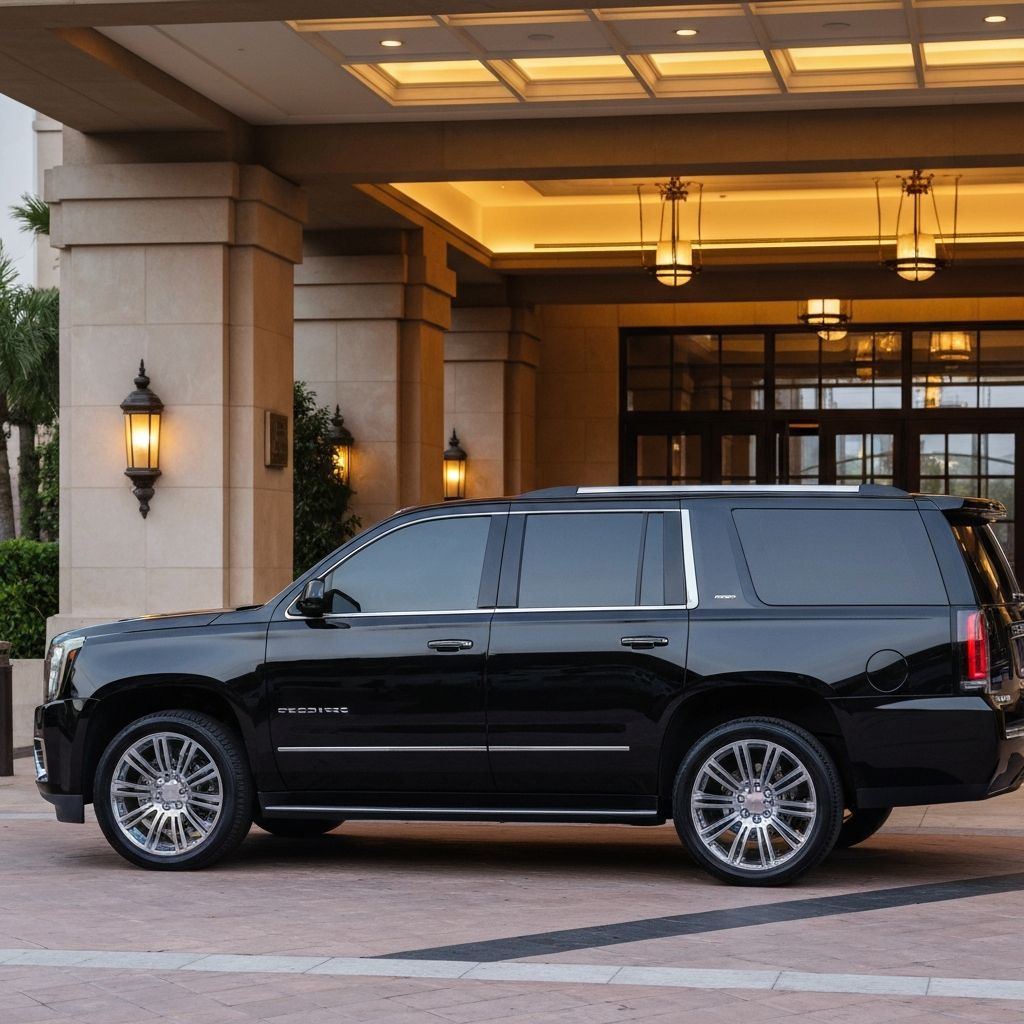
Vehicle preference is helpful, but it should be expressed as a preference rather than an assumption that a particular model solves every capacity question. We recommend confirming the proposed vehicle against the exact passenger and luggage mix for your itinerary. A luxury SUV may be a practical option for a smaller group with ordinary luggage, while a Sprinter or larger group vehicle may be worth discussing for more passengers, more checked bags, or bulky equipment. The right choice also depends on trip length, planned stops, and whether every passenger must travel in the same vehicle.
- Count large suitcases separately from carry-ons and personal items.
- Describe unusual equipment and give dimensions when that could affect loading.
- Ask us to confirm that the recommended vehicle suits passengers and belongings for the whole itinerary.
| Trip profile | Vehicle discussion to request | |
|---|---|---|
| Two to four passengers with modest luggage | Ask whether a luxury SUV is appropriate for the seating and bag count. | |
| Several passengers with checked bags | Ask whether an SUV, Sprinter, or another group arrangement best fits passengers and bags. | the confirmed luggage volume. |
| Golf, event, or display equipment | Confirm storage space and loading expectations before accepting the vehicle plan. | vehicle recommendation. |
6. Stops, waiting time, billing, and return transportation
A direct transfer is simpler to organize than an itinerary with several stops or an extended standby period. List stops in sequence and estimate how long passengers expect to be away from the vehicle at each one. Examples include collecting a colleague, stopping at a hotel, visiting a venue for photographs, waiting during a meeting, moving between wedding locations, or transporting a group to and from a sports event. State clearly whether the vehicle should remain available or whether a separate pickup will be needed later.
For corporate limo Toronto requests, identify the booking contact, the traveller or lead passenger, the billing contact, and any reference number or purchase-order process needed before service. Keep personal payment information out of an informal itinerary message unless the provider gives you a secure process for it. For a return, provide the date, expected pickup location, and either a firm time or the event that will determine the time. If the end time is uncertain, ask how changes, additional waiting, or a separate return booking should be handled.
- List every stop and approximate duration, including short passenger pickups.
- State whether the vehicle is needed on standby during an appointment or event.
- Provide a billing contact and a return plan before accepting the final arrangement.
| Itinerary type | Information to provide | |
|---|---|---|
| Hourly or standby service | Expected start and end times, stops, waiting pattern, and authorized contact. | person authorized to update the itinerary. |
| Wedding transportation | Hotel, photo locations, ceremony, reception, guest movements, and return plan. | person coordinating timing. |
| Business transportation | Traveller names, office entrances, billing contact, cost reference, and timing. | and any return requirement. |
7. Accessibility, service animals, and contingency plans
Discuss accessibility, service animals, child seats, and contingency plans before confirming the booking. Describe any mobility device, whether it folds, its approximate dimensions, and the assistance the passenger expects. Ask the provider to confirm whether the proposed vehicle and boarding arrangement are suitable. Identify the person authorized to approve timing or route changes, and keep a reachable day-of contact on the itinerary. If a flight or event schedule changes, contact the provider through the confirmed channel. This guidance supports a clear transportation plan; individual circumstances and applicable requirements may differ, so verify the arrangement directly for the requested trip.
- Describe the aid, transfer needs, support person, and boarding requirements specifically.
- Identify a service animal in advance and confirm the day-of-travel arrangement.
- Ask what happens if a flight, meeting, ceremony, or event end time changes.
| Need to clarify | Example question | |
|---|---|---|
| Mobility aid | “Can the proposed vehicle carry a non-folding wheelchair safely?” | |
| Passenger transfer | Can you confirm whether this vehicle suits the passenger’s boarding requirements? | transfers into a standard seat?” |
| Timing change | Who should we contact if flight or event timing changes, and what is the process? | information will you need from us?” |
Copy-and-paste booking brief
Date: ____. Pickup time or window: ____. Hard arrival deadline and reason: ____. Pickup address, building, and entrance: ____. Destination: ____. Stops in order: ____. Passengers: ____. Children and ages: ____. Large luggage, equipment, or item dimensions: ____. Mobility, boarding, support-person, or service-animal needs: ____. Airline, flight number, terminal, or event details: ____. Waiting or standby requirement: ____. Return date, location, and timing: ____. Day-of-travel contact: ____. Billing contact or reference: ____. Preferred vehicle: ____. Questions requiring written confirmation: ____.
A simple itinerary-planning calculation
Total planned service time = pickup and loading time + estimated driving time + each planned stop + waiting time + a contingency allowance. For an airport departure, work backward from the airport arrival time you need, not simply from the flight’s published departure time. For a meeting or event, work backward from venue access, registration, unloading, or the actual ceremony time rather than only the headline start. This is a planning tool, not a promise of travel time. Ask us to confirm the practical schedule, vehicle, route, availability, and price for the specific date and itinerary.
The four-part booking check
Before accepting a quote, check four areas. Fit: can the vehicle suit passengers, luggage, equipment, and boarding needs? Flow: are every address, entrance, stop, and waiting instruction clear? Fixed points: are flight, meeting, ceremony, or event deadlines identified? Fallback: does everyone know what information to provide if a flight, meeting, or event time changes? If any answer is unclear, request confirmation before finalizing the booking.
When your itinerary is ready, submit a booking or quote request through /book. You can review our transportation services at /services, compare listed vehicle options at /fleet, or use /contact for questions that do not fit the booking form. For corporate planning, visit /corporate before submitting your request.