What is the best way to plan golf transportation in Toronto?
The best way to plan golf transportation in Toronto is to work backwards from the time your group must be ready at the course. Confirm the course address and correct entrance, determine how early players need to arrive, count passengers and golf bags, then build the pickup sequence around realistic loading and travel time. A tee time is fixed; the transportation plan needs enough room for the variables that occur before it.
For a private round, charity tournament, corporate golf day, or trip from Toronto to another Ontario community, transportation planning is about more than finding a vehicle with enough seats. Golf bags, footwear, weather layers, permitted personal items, multiple pickup points, and pre-round registration can all affect the itinerary. At Toronto A1 Limo, we review the course, date, tee time, passenger count, equipment details, pickup locations, requested stops, and return plan before confirming an itinerary.
Our confirmation process matters because vehicle availability, equipment capacity, routing, timing, and pricing depend on the actual trip details. Sharing a complete request early helps us assess the appropriate vehicle and schedule rather than making assumptions based only on the number of golfers.
- Start with the course’s required arrival time, not only the listed tee time.
- Count every golf bag, personal item, and passenger before selecting a vehicle.
- Confirm whether the outing is a standard round, tournament, corporate event, or multi-stop day.
- Name one lead passenger who can confirm last-minute details with the group and chauffeur.
Step 1: Confirm the course, event, and arrival instructions
Before you book a Toronto golf transportation service, verify the destination directly with the golf course or tournament organizer. Confirm the correct address, designated entrance, clubhouse or bag-drop location, and preferred passenger drop-off point. Some properties have separate routes for regular players, event registration, large vehicles, or guest parking, so a map pin alone may not provide enough direction.
For organized competitions, use event-specific information instead of relying on the course’s normal daily procedures. Golf Ontario publishes championship schedules, registration information, event contacts, and competition details for provincial events. Those materials can help participants identify the host course, date, and event requirements that may affect arrival planning.
Ask practical questions before travel day: Is there a registration desk? Does the group need to report to a specific area? Is bag drop available? Is there a designated place for a chauffeur to wait after the round? Course staff and organizers set these policies, and we plan transportation around the instructions they provide.
- Record the complete course name and street address.
- Confirm the appropriate entrance and passenger drop-off area.
- Ask whether tournament registration, breakfast, or a briefing changes the required arrival time.
- Save the organizer or pro-shop contact information with the trip details.
Step 2: Calculate a departure buffer that protects the tee time
Use a simple backward-planning calculation: start with the tee time, subtract the time needed at the course before play, subtract estimated driving time, and subtract a loading and traffic buffer. The result is the planned departure time from the first pickup. This method gives the group a schedule to follow while recognizing that traffic and loading are part of the trip, not afterthoughts.
For example, a group with a 9:00 a.m. tee time may want to arrive 45 minutes early for check-in, bag handling, and warm-up. If the estimated drive is 60 minutes and the group allows 30 minutes for loading and traffic variability, the planned departure from the first pickup is 6:45 a.m. If there are several pickups, the itinerary must begin earlier so each stop is included before the final departure toward the course.
This is a planning tool, not a guarantee of travel time. GTA road conditions, construction, collisions, weather, special events, and delayed passengers can change the day. For unfamiliar courses, early-morning rounds, tournament registration, or groups departing from several addresses, build in additional time. The course or organizer’s stated arrival requirement should always take priority over a generic timing rule.
Golf Canada’s tournament-registration guidance advises competitors to check tee-time information shortly before play. That is a useful reminder for any group: reconfirm the actual start time and course instructions close to the date rather than relying on an older group message.
| Planning item | Example timing | Why it matters |
|---|---|---|
| Tee time | 9:00 a.m. | This is the fixed time the itinerary must protect. |
| Required arrival time | 8:15 a.m. | This allows time for check-in, bag handling, and pre-round preparation. |
| Estimated driving time | 60 minutes | This forms the route portion of the plan, subject to conditions. |
| Loading and traffic buffer | 30 minutes | This accounts for passenger boarding, golf bags, and normal variability. |
| Planned first departure | 6:45 a.m. | This creates a workable target for the first pickup. |
Step 3: Match the vehicle to players, golf bags, and trip format
Passenger count alone does not determine vehicle fit. Four golfers can bring four full-size bags, shoes, outerwear, umbrellas, valuables, and personal luggage. A group returning to a hotel or continuing to dinner may also have additional items. Equipment volume should be discussed separately from seating so that the group does not assume every passenger seat corresponds to suitable bag capacity.
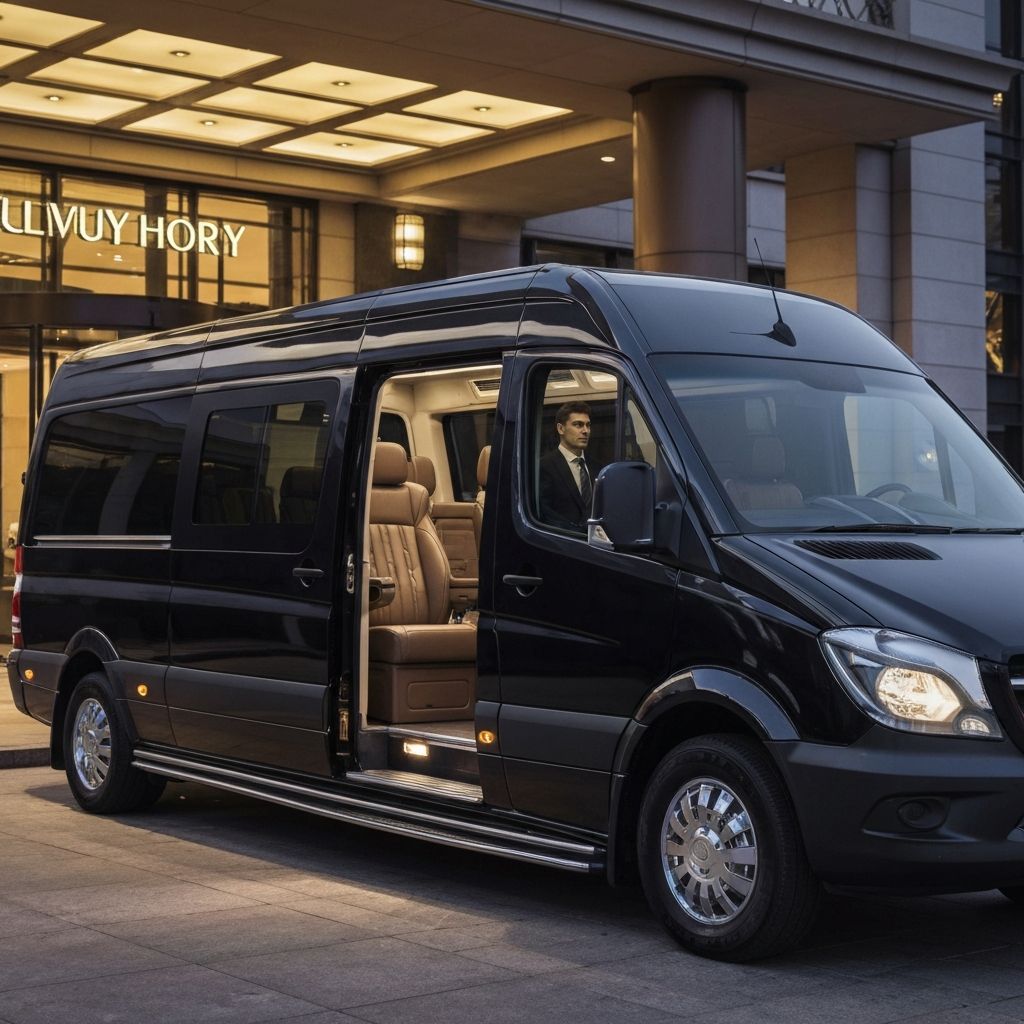
Our public fleet pages list Cadillac Escalade, Chevrolet Suburban, GMC Yukon XL, Mercedes Sprinter, stretch limousine, and party-bus options. The right option depends on the specific vehicle available, the number of passengers, the bag count and bag style, route length, pickup configuration, and requested service date. We assess the actual itinerary before confirming that a particular vehicle is suitable.
A smaller group traveling with standard golf bags may have different needs from a corporate group with participants, event signage, prize materials, or overnight luggage. Likewise, a Sprinter may suit a group that values shared space and coordinated pickups, while an SUV arrangement may fit a smaller party with a simpler route. Review vehicle options with the equipment list in hand, not after the vehicle is selected.
- Provide the exact number of golfers and non-golfing passengers.
- State the number of full-size golf bags, travel bags, and other large items.
- Mention whether anyone is bringing overnight luggage or tournament materials.
- Do not pack bags in a way that obstructs passenger entry, exits, or safety equipment.
Step 4: Set the pickup order and list every intermediate stop
A golf group may start from one residence, several homes, a downtown hotel, an office, or an airport-area property. Give us the complete pickup sequence, including unit or entrance details where relevant. The first address, each additional stop, and the final course address all affect departure time and routing.
For hotels and offices, identify the official driveway, loading area, or lobby entrance the group should use. Large urban properties can have more than one entrance, and an imprecise pickup point can consume the buffer built into the itinerary. The lead passenger should be ready to communicate with the rest of the group and help ensure players and bags are ready when the vehicle arrives.
Include breakfast, coffee, equipment collection, practice-range visits, registration stops, and player pickups in the original request. An intermediate stop may be feasible, but it changes the route and timing. It should be reviewed in advance rather than introduced casually on travel day. The same approach applies to a detour after the course for dinner, a hotel, or another venue.
Step 5: Decide on the return plan before the first tee
The end of a golf day is usually less predictable than the start. Pace of play, weather interruptions, a post-round meal, prize presentations, and time spent in the clubhouse can all move the return departure. Decide before the outing whether the group needs a fixed pickup time, a defined pickup window, or another arrangement that we confirm in advance.
A fixed time can work well for a corporate event with a scheduled reception, a tournament with an established agenda, or a group that must return for another commitment. A time window may make more sense for a casual round, subject to the confirmed service arrangement. In either case, establish the exact post-round meeting point and designate the lead passenger who will provide updates if timing changes.
Before play begins, ask the course where the vehicle may wait or collect passengers. Do not assume the morning drop-off point is automatically available at the end of the day. If the group is splitting after golf, provide the destination sequence ahead of time so we can review the revised routing and vehicle time required.
- Choose a fixed pickup time or a confirmed return window.
- Confirm the pickup meeting point with the course.
- Provide the lead passenger’s reachable phone number.
- List dinner, hotel, office, or home drop-offs in the requested order.
Weather, delays, and changes to the golf plan
Golf transportation should support the outing, but course-operation decisions remain with the golf course or event organizer. Frost delays, lightning procedures, cart restrictions, course closures, and tournament schedule changes are determined by those parties. A sound transportation plan includes communication steps without assuming that play will continue or that the original timeline will remain in effect.
If weather or an organizer changes the plan, send us the revised course, date, tee time, passenger count, pickup sequence, and return requirement as soon as possible. A rescheduled or materially changed trip may require a new availability, route, vehicle, and pricing review. We do not assume that a previously discussed vehicle, rate, or timing automatically applies to a replacement itinerary.
For Ontario tournament participants, Golf Ontario’s competitive schedule and event information can help verify dates and locations. Check the relevant organizer communications close to travel day, especially when the group is traveling outside Toronto or coordinating around a formal event schedule.
Golf transportation booking checklist
A complete request lets us review the trip efficiently and gives your group a clearer travel plan. Send the practical facts first, then add preferences such as a preferred vehicle type or planned stop. If any item is uncertain, say so; it is better to identify an open question than to treat it as confirmed.
For additional trip-preparation guidance, readers can use our related article, What to Tell a Toronto Limo Service Before You Book. For a direct golf-service discussion, use our Toronto golf transportation service page. We can then review the requested date, route, passenger group, golf equipment, and return requirements together.
- Course name, full address, correct entrance, and arrival requirement.
- Date, tee time, and tournament or event name where applicable.
- Every pickup address, pickup order, and requested intermediate stop.
- Passenger count, golf-bag count, luggage, and any large event materials.
- Preferred departure time, return arrangement, and post-round destinations.
- Lead passenger name and contact number for day-of coordination.
Departure-time formula
Departure time = tee time − required pre-round time − estimated travel time − pickup and traffic buffer. Example: 9:00 a.m. tee time − 45 minutes − 60 minutes − 30 minutes = 6:45 a.m. planned departure.
Golf booking completeness check
A request is ready for review when it includes the course address, arrival requirement, passenger count, golf-bag count, pickup sequence, intermediate stops, return plan, and a contact for schedule changes.
Ready to coordinate your golf outing? Submit your course, tee time, passenger count, golf-bag details, pickup locations, and return plan through our booking page, or contact us at 647-386-3868 so we can review the itinerary.